
The World Economic Forum estimates that 44% of workers’ core skills will change by 2027, and that shift is already shaping what “prepared” looks like for today’s students. Career-ready STEM is no longer about cramming facts and formulas for a test. It is about learning how to investigate, build, validate, and explain ideas clearly.
That’s why STEM afterschool programs are so effective in building science and research skills: they create space for real projects, practical feedback and mentorship that is hard to fit into a standard school timetable. The best programs tend to teach the same foundation: research and engineering habits that translate to college, internships, and early careers.
Skill 1 – Research Thinking: Asking Better Questions and Framing Problems
Turning Curiosity into A Testable Research Question
A strong project starts with a strong question. Research thinking teaches them to narrow that topic into something testable and meaningful.
Writing Hypotheses and Defining Variables and Constraints
Afterschool science and research skills are built when students learn to think like scientists: identify independent and dependent variables, decide what must stay constant and acknowledge constraints (time, tools, sample access).
Choosing Real-World Themes (Biomed, Environment, Community)
In STEM afterschool programs, students learn to choose problems they can realistically investigate where high-intent projects often live at the intersection of relevance and feasibility.
Students working on health or environmental problems often find this approach strengthens their readiness for rigorous coursework like an AP biology prep course, where hypothesis-driven thinking is essential.
Skill 2 – Experimental Design and Data Fluency (Evidence That Holds Up)
Controls, Sampling, Bias, And Repeatability
In the sciences, the fastest way to build credibility is to run experiments that hold up under questioning and to handle data responsibly.
Students quickly learn that one trial proves nothing. A thoughtful design includes controls, enough trials to reduce randomness, and a plan to minimize bias.
Data Collection and Data Hygiene (Clean, Consistent Records)
Messy data can sink a great idea. Students should practice consistent labeling, units, timestamps, and structured documentation. A simple habit like recording conditions the same way every time often matters more than fancy tools.
Basic Analysis and Visualization Students Should Practice
Students don’t need advanced math to think clearly with data. They do need basics: averages, variability, simple comparisons, and graphs that communicate a point quickly.
This is also a practical bridge for students who want to enroll in practical-first biology classes for teens, as it strengthens lab-style reasoning instead of pure memorization.
Skill 3 – AI Literacy for Student Researchers
Where AI Supports Student Research (Ideas, Coding, Analysis)
AI can accelerate student work, but only if students learn to treat it like an assistant. Students can use AI to brainstorm experimental approaches, generate starter code for analysis, or summarize background concepts.
How to Verify AI Outputs
Students should cross-check claims with primary sources, test code on small sample datasets, and document what they asked and what they accepted or rejected. This habit separates a confident presenter from someone who copied an answer.
Responsible AI Use in Student Projects (Privacy, Bias, Transparency)
Students should avoid uploading sensitive data, watch for biased assumptions, and disclose when AI supported their workflow. In rigorous STEM afterschool programs, transparency and taking ownership are key parts.
Skill 4 – Bioengineering Prototyping and Iteration
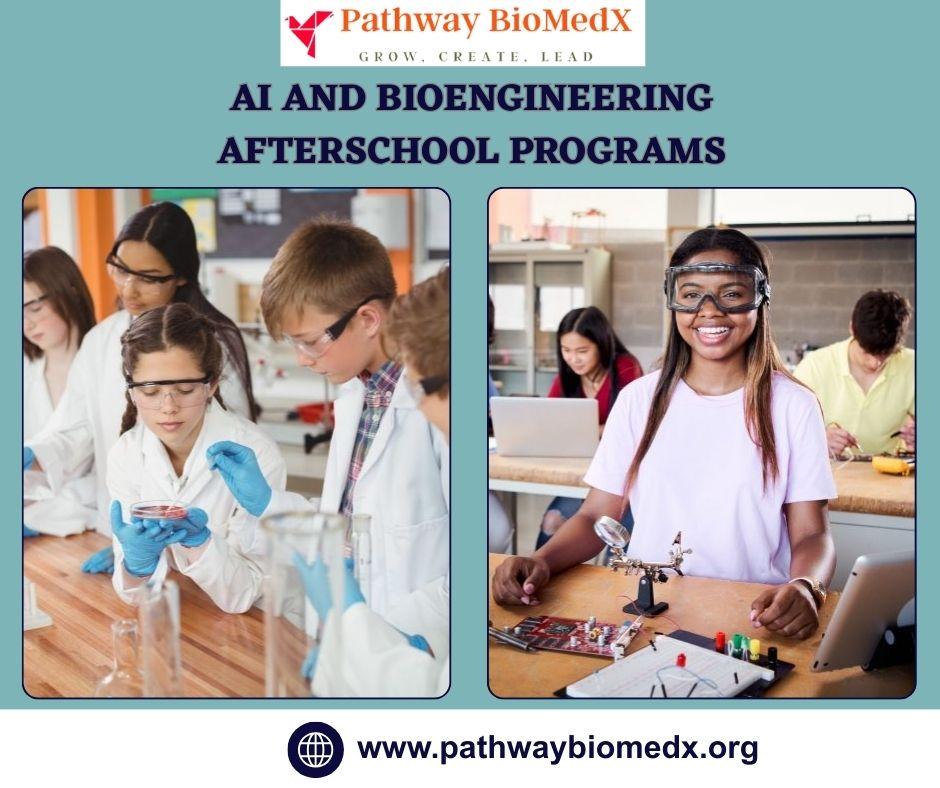
Bioengineering Mindset: Designing with Biological Constraints
Bioengineering teaches students to design with constraints: biology is variable, materials fail, and real users have real needs. That’s why prototyping is such a career-relevant skill.
Instead of “build once,” students learn to design around limitations like contamination risk, sensitivity vs. specificity, and usability. This also builds intuition for biotech pathways without requiring a full lab.
Prototyping Habits: Iteration Logs, Troubleshooting, Refinement
Students should keep iteration logs, note what failed, and explain what changed. Those notes often become the backbone of a student research portfolio for college, because they show decision-making, not just results.
Why AI and Bioengineering Afterschool Programs Create Strong Portfolios
AI and bioengineering afterschool programs often shine because they produce tangible artifacts: a model, a testing plan, a prototype, and a clear explanation. These are easier to showcase than worksheets, and they mirror real STEM workflows.
Skill 5 – Scientific Communication and Collaboration
Communicating Results: Notebooks, Abstracts, Posters, Demos
Even brilliant work gets ignored if students can’t communicate it. Students should practice building a narrative: problem, method, results, and limitations. A clear poster or demo forces clarity and helps students explain their work in interviews.
Collaboration Skills: Roles, Peer Review, Feedback, and Accountability
Team projects teach practical habits: assigning roles, setting timelines, giving useful feedback, and keeping shared documentation. These are exactly the skills employers and research mentors notice first.
Conclusion: Turning Afterschool STEM into Career Readiness
An effective afterschool science and research skills program helps students ask sharper questions, design cleaner experiments, use AI responsibly, prototype like an engineer, and communicate clearly. It’s building career readiness. The best STEM afterschool programs leave students with proof of growth: a portfolio artifact, stronger confidence, and the ability to explain their thinking.
If you want a STEM program designed around research habits, modern AI workflows, and problem solving, Pathway BioMedX‘s future-readyafterschool STEM programs for Middle and High Schoolersoffer the right exposure.
Start now and register in our Pathway Initiative Programs today!
FAQs
1. What age/grade is best to start STEM afterschool programs?
Late elementary to middle school is great for exploration, while high school is ideal for deeper projects and portfolio building.
2. How do I know if a program truly teaches research?
Look for hypotheses, controls, data analysis, and documentation requirements.
3. What portfolio items should students produce by the end of a program?
A research brief or poster, a dataset with charts, a short reflection on iterations, and a demo or presentation recording.
4. Are AI and bioengineering afterschool programs suitable for beginners?
Yes, if they teach verification and fundamentals first, then scale complexity through guided projects.
5. How many hours per week are ideal for afterschool science and research skills building?
Aim for 3 to 6 hours weekly to allow experimentation, iteration, and real feedback without burnout.